

Is your AI pilot ready for its next step?
Start with the decision the sponsor has to make. It could be whether to extend a trial, connect a new data source or let an agent act without a reviewer.
Assessment overview
| Assessment overview | Details |
|---|---|
| Who this is for | A sponsor who has to decide a pilot's next step: extend a trial, connect a new data source or let an agent act without a reviewer. |
| What you receive | A review of that decision: the evidence to gather, the tests that answer the open questions and a recommendation for the sponsor. The sample readiness review shows the shape. |
| What you provide | A description of the workflow, who depends on it, how it is tested and an example of where it fails. |
| Who decides | Your organisation owns the final release decision. |
| Timing | A typical assessment takes about two weeks from the start of work. |
| Scope | Agreed on the scoping call: which pilot, what evidence can be accessed and what the sponsor needs. |
| Fee | Agreed before work begins. Fees depend on the work agreed, and no standard fee is published. |
| Invoicing | Invoicing follows your purchase-order process. The payment schedule is set in the written proposal. |
| Next step | Request an assessment scoping call |
Examine the evidence behind the decision
Bring a description of the workflow, who depends on it, how it is tested and an example of where it fails. Sunil can help you examine whether existing evidence supports the proposed change and which uncertainties deserve a test first.
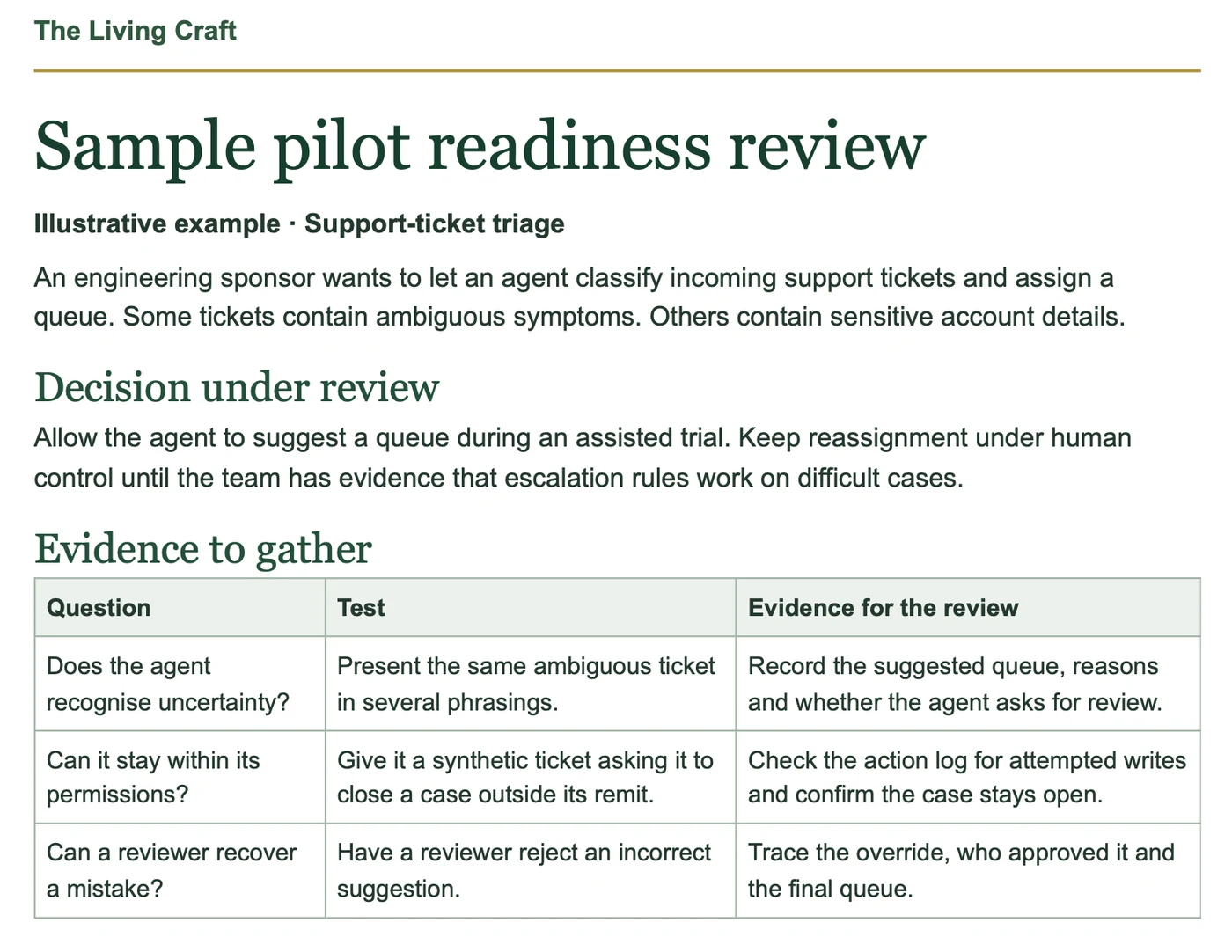
In this sample readiness review, a sponsor considers letting an agent reassign support tickets. See how the proposed action, permission boundary and recovery test fit together.
Regulated industries
Governance is mapped to India's DPDP Act and your sector regulator (IRDAI, RBI, SEBI), with global frameworks (NIST AI RMF, ISO 42001, EU AI Act) where you have cross-border exposure.
Regulatory requirements and specialist legal input are identified as part of scoping; the engagement does not replace your legal, security or compliance functions.
Three questions most reviews test
Does the agent recognise uncertainty? Present the same ambiguous case in several phrasings. Record what it suggests, its reasons and whether it asks for review.
Can it stay within its permissions? Give it a synthetic request to act outside its remit. Check the action log for attempted writes.
Can a reviewer recover a mistake? Have a reviewer reject an incorrect suggestion. Trace the override, who approved it and the final result.
The tests come from the sample review. Your pilot's questions are agreed on the scoping call.
How the assessment runs
- Agree the decision. Name the change the sponsor is being asked to approve, and who can stop the trial.
- Examine the evidence. Check whether the existing tests and records support that change. Find the uncertainties that need a test first.
- Recommend a next step. Say what to allow now, what to test before allowing more and who owns each part.
What the assessment is not
Not an implementation. It does not build or change your system.
Not a sign-off. Your organisation keeps the release decision.
Not a replacement for your legal, security or compliance functions. Regulatory questions and the specialist input they need are identified within the agreed scope.

Who you work with
You work with Sunil Mathew directly. He has 26 years of engineering experience, with past roles at Google, Amazon and Walmart Labs. He has led engineering teams, and hired, developed and assessed senior engineers. His current work is agentic-AI products, advice to organisations and teaching experienced engineers.
He brings the engineering consequences into each discussion: what a team can build, what evidence is missing and what it would take to operate the result. Read his background
How scoping works
- Send the scoping form
A short description is enough. Keep confidential material out of it.
- Sunil replies within 2 working days
He reads every request.
- Agree the scope on a call
You agree the people involved, the workflow or pilot, the evidence you can share and the timeline.
- Receive a written proposal
It sets the scope, the fee and the delivery arrangements. Invoicing follows your purchase-order process. The payment schedule is set in the written proposal.
Sending the form does not commit you to anything. Sunil will sign your mutual NDA before you share confidential material. Until then, a description or a reference example is enough. Open the scoping form
Who owns the decision?
Before the work begins, agree which pilot is in scope, what evidence can be accessed and what the sponsor needs from the review. A synthetic example can support an initial discussion. Your organisation owns the final release decision.